
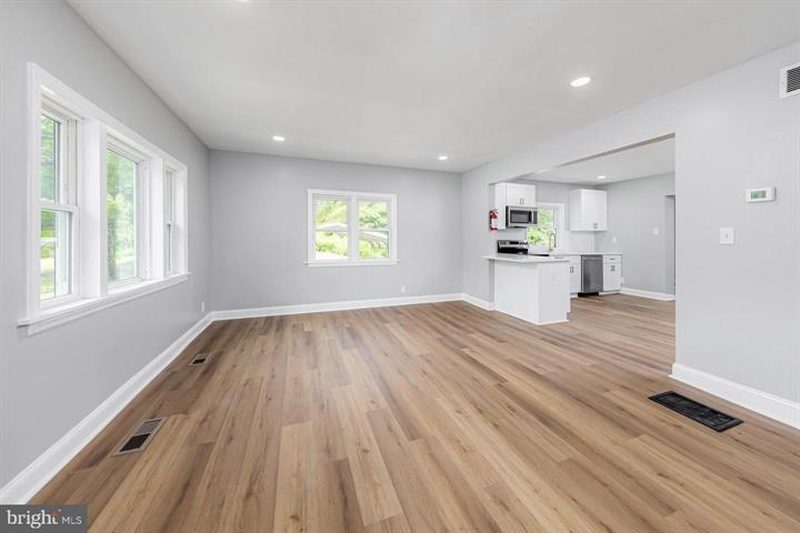
A completed Northbound Home Buyers purchase in Quinton, Salem County, NJ.
📋 In This Article
You find out about it in one of three ways. You already knew — there is a fill pipe sticking out of the lawn and a vent pipe on the side of the house, and the tank has not been used since the furnace was switched over years ago. Or the buyer's inspector runs a metal detector across the yard and finds something. Or you inherited the house and nobody can tell you whether the old tank was ever pulled.
However it surfaces, an underground heating-oil tank is one of the most common reasons a South Jersey sale slows down or falls apart. Plenty of older houses across the region were built to burn oil — from post-war neighborhoods in Pennsauken and Berlin to farmhouses and rural lots in Salem and Cumberland counties — and many of those tanks are still in the ground. This guide explains what New Jersey law actually requires of you, what changes if the tank has leaked, and how to sell without the tank taking over your timeline.
Why Oil Tanks Stall South Jersey Sales
The tank itself is rarely the problem. The unknown is. A steel tank that has sat in the ground for decades may be perfectly intact, or it may have been slowly leaking into the soil for years, and nobody knows which until it comes out. A buyer who is financing the purchase has to answer to a lender and a homeowners insurer, and an unknown underground tank is exactly the kind of question both like answered before closing.
So the pattern repeats: the tank comes up in the inspection, the buyer asks you to remove it before closing, the removal finds contamination, and a 30-day closing turns into a remediation project with an open state case. None of that is unusual. It is just slow, and the seller usually carries the cost and the carrying time.
Do You Have to Remove It Before You Sell?
No — not under state law. Residential heating-oil tanks are what the New Jersey Department of Environmental Protection calls unregulated heating oil tanks (UHOTs). The DEP does not regulate how you operate them. Its own homeowner guidance says that if there is no indication of a discharge, there is no state requirement that the tank be removed, including when you sell.
The same guidance goes on to say what everyone in the business already knows: it is common for real estate professionals to recommend removing the tank before a sale. And if a discharge is discovered during that removal, remediation is required. In other words, the law does not force the tank out, but the market often does — and pulling it is the moment you find out whether you have a bigger problem.
That is the real decision. Leaving the tank in place and disclosing it keeps your options open but narrows your buyer pool. Pulling it gives a financed buyer the answer they want, but it can open a cleanup you then have to finish.
How a Legal Tank Removal Works
If you decide to take the tank out, New Jersey sets out who can do it and how it is permitted:
| Step | What New Jersey requires |
|---|---|
| Who removes it | A closure-certified individual working for a closure-certified UST firm. The DEP lists firms with a “CLOSURE” or “HHO CLOSURE” certification. |
| The permit | Tank removal falls under New Jersey's Uniform Construction Code, so the permit comes from your town's construction office, not from the DEP. |
| The inspection | The tank is pulled and checked for holes or signs of a discharge. If it is clean and passes the municipal inspection, the town closes the permit and you are done. |
| No-leak paperwork | The DEP does not issue a No Further Action letter when there was no discharge. The closed municipal permit is your record. |
Two details catch people out. First, a closure contractor can only clean up a leak if the firm is also certified for subsurface evaluation. If yours is not, a leak means hiring a second firm mid-job. Ask before you sign.
Second, tanks that were “abandoned in place” long ago — emptied and left in the ground, sometimes filled with sand — are not automatically settled. The DEP notes that the construction code does not require a permit for a tank that has been out of service for a long period, but recommends getting one where available, and if an old abandoned tank shows signs of a discharge when it is examined, the leak rules below apply in full. Not sure whether a tank was ever removed from your property? The DEP's suggestion is to file an Open Public Records Act request with your municipality for any tank-removal permits on the address.
If the Tank Has Leaked
This is where the timeline stretches. Once a discharge is discovered, the clock starts immediately:
- Report it. The DEP must be notified within 15 minutes of discovery through its hotline, 1-877-WARNDEP (1-877-927-6337). Either you or the contractor can call, and certified closure contractors are required to. That call opens an incident on your property's address.
- Hire the right professional. The cleanup has to be done under the Heating Oil Tank System Remediation Rules (N.J.A.C. 7:26F) by either a certified subsurface evaluator working for a certified firm or a Licensed Site Remediation Professional (LSRP).
- Sample the soil. The rules require at least five soil samples from the excavation — one from each sidewall and one from the base, depending on its size. If every sample comes back under 1,000 mg/kg of extractable petroleum hydrocarbons, no further soil cleanup is needed.
- Check the groundwater if required. A groundwater investigation is required when any part of the tank system sits within the seasonal high water table or within two feet of groundwater or bedrock. In the low-lying parts of South Jersey, where the water table can be shallow, that is worth asking about up front.
- Close the case. The certified firm submits a Remedial Action Report and a signed UHOT form, the DEP invoices a non-refundable $400 review fee, and if the work was done properly the DEP issues a No Further Action (NFA) letter. The DEP says a complete package typically takes about two to four weeks to review.
The NFA letter is the document buyers, title companies and towns want to see. Some municipalities will not close the original removal permit without it — which means an open permit sitting on the property until the remediation is finished and approved.
Don't sit on a known leak
A leak does not get cheaper with time, and it does not go away when the house changes hands — it has to be disclosed, and the open DEP case stays tied to the address. If you already know the tank has leaked, talk to a New Jersey environmental attorney or an LSRP about where the cleanup stands before you list or sign anything.
What You Have to Disclose
New Jersey's standard Seller's Property Condition Disclosure Statement, set out in the state's consumer-fraud regulations at N.J.A.C. 13:45A-29.1, asks about tanks more than once. It asks whether you are aware of any tanks on the property, above or below ground, used to store fuel; whether, if a tank is no longer in use, you have a closure certificate; whether you know of any underground storage tanks now or previously present on the property; and whether any underground tank has been tested, with a request to attach the test reports or closure certificate.
The form also reminds sellers that they must disclose any known material defect even if the form does not ask about it. So the practical rules are simple:
- If you know there is a tank, say so, whether it is in use, abandoned or filled.
- If a tank was removed, say so and attach the paperwork — the closed permit, and the NFA letter if there was a leak.
- If you genuinely do not know, answer “unknown” honestly rather than “no.” Inherited and long-vacant houses are often in this category; our guide to selling an inherited house in South Jersey covers the other paperwork that comes with an estate sale.
The tank is one of several things that come up at resale. Our guide to the smoke and CO certificate and town resale inspections covers the municipal side of selling, and selling a flood-zone house covers the flood questions on the same disclosure form.
The State Grant Fund: Don't Count On It
You may see contractors advertise that the state will pay for your tank removal. Be careful. The Petroleum Underground Storage Tank Remediation, Upgrade and Closure Fund (the UST or PUST Fund), created in 1997 and run by the New Jersey Economic Development Authority with the DEP, has been short of money for years:
- Since May 3, 2011, the fund no longer accepts or processes applications for non-leaking tanks.
- Applications for leaking residential heating-oil tanks are still accepted and date-stamped, but the DEP says they are not reviewed or processed until funding becomes available.
- The DEP states plainly that it knows contractors advertise no-cost removal, and that the fund has never guaranteed funding to anyone.
If you have a leak, applying costs nothing and may pay back later, so it can be worth doing. But do not build your sale around money that may arrive long after closing, or not at all.
Your Options as a Seller
- Find out what you have. Look for a fill or vent pipe, check your own records, and file an OPRA request with the town for any removal permits. Knowing beats guessing on the disclosure form.
- Remove it before you list. Best if you have time, cash for the removal, and a cushion in case it has leaked. A clean removal with a closed permit is the cleanest story you can hand a financed buyer.
- Disclose it and let the buyer negotiate. Some buyers will accept a tank in place with a price adjustment or an escrow at closing. Many lenders and insurers will push back, so expect fewer offers and a longer contract period.
- Sell as-is to a cash buyer. No lender means no lender condition, and the tank is priced into the offer up front instead of discovered during escrow. Our page on selling your house as-is for cash shows how that works.
That last option is what we do. We buy South Jersey houses with tanks in the ground — in use, abandoned, or simply unknown — and we do not ask you to remove the tank, run the sweep, or pay for anything before closing. Our offer accounts for the tank, and after closing the removal is our project. If a leak has already been found, we still look at the house; tell us where the DEP case stands and we will factor it in honestly. Our offer is below full retail value, and our comparison page lays out that trade-off without spin. You can see the kind of house we take on in our Quinton project — a Salem County house with a failing septic that no financed buyer could touch. More on selling a house that needs work is in our guide to selling as-is in South Jersey, and how it works covers our timeline.
We buy throughout the parts of South Jersey where older oil-heated houses are common, including Salem County, Millville and Cumberland County, and the older towns of Camden County.
The Bottom Line
New Jersey does not make you pull an old heating-oil tank before you sell. It does make you disclose what you know, and if the tank has leaked, it makes you report it within 15 minutes and clean it up under the DEP's rules before the case is closed. The tank only becomes a crisis when it is discovered in the middle of a financed sale with a closing date already set.
If you would rather not find out the hard way, call Northbound Home Buyers at (856) 226-4289. We will tell you what the house would sell for as it stands, tank and all, and what you would walk away with. Our NJ seller closing costs guide shows the rest of the math, more answers are in our FAQ, and you can see everywhere we buy on our locations page.
This article is general information, not legal or environmental advice. Responsibility for a discharge can depend on your specific facts, so for your situation talk to a New Jersey attorney or a Licensed Site Remediation Professional.