
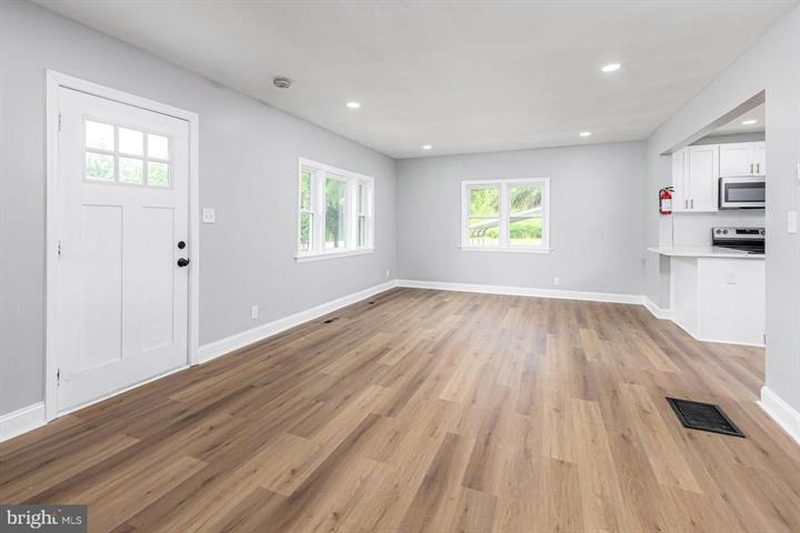
A completed Northbound Home Buyers purchase in Salem County, NJ.
📋 In This Article
- What changed in March 2024
- The flood questions you now have to answer
- SFHA, moderate risk, and what your zone means
- Where flood risk actually sits in South Jersey
- What a flood zone does to your buyer pool
- Flood insurance and the elevation certificate
- The 50% rule: when a flood forces an elevation
- If the house has already flooded
- Blue Acres: the state buyout nobody explains
- Your four realistic options, compared
- What changes when you sell to a cash buyer
Most of the flood conversations we have start the same way. Someone inherits a house near the Bayshore, or decides after one bad season that they are done bailing out a basement, and they discover that the sale is no longer just about the house. It is about the flood zone, the insurance quote, the disclosure form, and whether the buyer's lender is going to blink.
New Jersey made that conversation more formal in 2024. Sellers now answer a specific set of flood questions in writing, on the record, before closing. That is a good thing for buyers and it is genuinely workable for sellers — but only if you know what you are being asked and what your options are. This guide walks through both, for houses anywhere from Salem and Cumberland County's Delaware Bayshore to the back bays behind Atlantic City and Cape May.
What Changed in March 2024
The law is P.L. 2023, c.93. The Governor signed it on July 3, 2023, and it took effect for sales and leases on March 20, 2024, once the Division of Consumer Affairs published the amended form. It did two separate things: it created flood-disclosure duties for landlords, and it added a “Flood Risk” heading to the seller's property condition disclosure statement used in New Jersey residential sales.
What it did not do is create a penalty schedule for sellers. The statute is quiet on that point. The teeth are on the landlord side, where a tenant who was not given the required disclosure can terminate the lease. For a seller, the risk is the ordinary one that has always existed in New Jersey: a buyer who finds out about a flood history you concealed has a claim, and a deal that blows up inside attorney review costs you weeks you were not planning to spend.
The Flood Questions You Now Have to Answer
The Flood Risk block is short, and every question is answerable from records you either have or can get for free. In substance, it asks:
- Whether the property sits in a FEMA Special Flood Hazard Area or a Moderate Risk Flood Hazard Area.
- Whether federal law requires flood insurance on the property.
- Whether the property currently carries flood insurance.
- Whether a FEMA elevation certificate exists for the building.
- Whether the owner has ever received federal flood assistance — FEMA, SBA disaster loan, or similar.
- Whether a flood damage claim has ever been filed with an insurer.
- Whether the property has ever had flood damage, water seepage, or pooled water from a natural event.
The first two are lookups, not memories — NJDEP publishes a free flood-risk lookup specifically so owners can answer them accurately, and your municipal construction office can confirm the zone from the parcel. The last three are yours to answer honestly. If you are the executor of an estate and genuinely do not know the history, “unknown” is an available answer and an honest one; guessing is not. Our guide to selling an inherited house in New Jersey covers the rest of the paperwork an executor carries into a sale.
SFHA, Moderate Risk, and What Your Zone Actually Means
The labels sound worse than they read. A Special Flood Hazard Area is the area FEMA maps as having a 1% chance of flooding in any given year. It gets called the “100-year floodplain,” which is the single most misleading phrase in this whole subject — it does not mean a flood every hundred years, it means roughly one-in-a-hundred odds every single year, and those odds compound across a 30-year mortgage. On the maps it shows up as Zone A or AE inland and along tidal rivers, and Zone VE where wave action is expected along the open coast.
The Moderate Risk area is the 0.2% annual chance band — the “500-year” zone, shown as shaded Zone X. Flood insurance is not federally required there, which is exactly why buyers in that band so often carry none and are so unhappy when water arrives anyway.
Your zone is a mapping decision, not a verdict on your house
Two houses on the same street can sit in different zones, and a map revision can move you in or out without anything about the building changing. That is why the disclosure asks what zone the property is in rather than asking whether it floods — and why an elevation certificate, which measures your actual building, is worth more to a sale than the zone letter is.
Where Flood Risk Actually Sits in South Jersey
Flood risk in our market is not one thing. It comes in three distinct flavours, and they sell very differently.
The Delaware Bayshore and tidal creeks
Salem and Cumberland counties carry the state's longest stretch of tidal bayshore, and the flooding there is often nuisance-frequency rather than catastrophic: a run of high tides pushing up the creeks and over low-lying roads. Houses in Pennsville, Salem and the small communities around them sit close enough to the water that the zone question is rarely a surprise to the owner. We have bought in this corner of the state repeatedly — our Quinton pre-foreclosure project in Salem County is one of them.
The back bays behind the barrier islands
The flooding that reaches homes in Atlantic City, Egg Harbor Township and the Cape May communities is usually back-bay tidal flooding rather than ocean waves. It arrives on the marsh side, it arrives quietly, and it is the reason so much of the housing stock behind the islands is already elevated.
Inland stream and stormwater flooding
Further up in Camden, Gloucester and Burlington counties, the risk is rain-driven: creeks that come up fast, and older neighbourhoods where the stormwater system was designed for a different century. This is the flooding people least expect to see on a disclosure form, because the house is nowhere near open water. Our Cumberland County selling guide covers the market dynamics in the Millville and Bridgeton area in more detail.
What a Flood Zone Does to Your Buyer Pool
Here is the practical reality, and it is worth being blunt about it. A flood zone rarely stops a sale outright. What it does is add a gate, and every gate loses you buyers.
If the house is in a Special Flood Hazard Area and your buyer is financing it with a federally backed or federally regulated mortgage, the lender is required to make them carry flood insurance for the life of the loan. So the buyer has to go get a quote. That quote lands somewhere between “fine” and “this changes what I can afford,” and you find out which about ten days into the contract — often at the same moment the appraisal comes back. Deals that die this way tend to die late, which is the expensive kind.
The second gate is inspection. Any evidence of past water — a tide line in the crawlspace, replaced drywall stopping neatly at the same height in every room, a sump pump doing steady work — sends the buyer back to renegotiate. That is the same dynamic we describe in our guide to selling as-is in South Jersey: the deduction a retail buyer takes for a known problem is almost always larger than the problem.
Flood Insurance and the Elevation Certificate
Flood insurance in the United States mostly runs through the National Flood Insurance Program, and FEMA prices individual buildings rather than blanket zones — distance to water, the type of flooding, the building's construction and, critically, its elevation. Premiums are property-specific, so anyone who quotes you a South Jersey average is guessing. Get the actual quote for the actual address.
The document that moves that number is the elevation certificate: a surveyed record of how the building's lowest floor sits relative to the base flood elevation. If one already exists for your property, find it before you list. If a previous owner elevated the house or raised the mechanicals, the certificate is what proves it, and without it an insurer prices the building on assumptions that are rarely in your favour. The disclosure form now asks whether one exists, so you will be answering the question anyway.
The 50% Rule: When a Flood Forces an Elevation
This is the rule that catches sellers of already-damaged houses completely off guard, and it is worth understanding before you commit to repairing rather than selling.
FEMA's floodplain standards, enforced locally by your municipality's floodplain administrator, treat repair or improvement work costing 50% or more of the structure's pre-damage market value as “substantial.” Once work crosses that line, the building is no longer being repaired — in regulatory terms it is being newly constructed, and it has to meet current floodplain standards. In New Jersey that generally means the lowest floor has to reach the design flood elevation, which is FEMA's base flood elevation plus a foot of freeboard.
In plain terms: a flood-damaged house in the floodplain can go from “needs $80,000 of repairs” to “needs $80,000 of repairs and a structural elevation” on the strength of one determination by a municipal official. That determination belongs to the town, not to your contractor and not to your insurer. Before you spend a dollar on a substantial repair to a floodplain property, ask the construction office where they think you land.
If the House Has Already Flooded
A house that has taken water is not unsellable. It is a different sale, and it rewards documentation.
Pull together what you have: the claim history, any remediation invoices, permits pulled for the repair work, and the elevation certificate if one exists. A buyer who is handed a folder is negotiating about a known quantity. A buyer who has to discover the history through an inspector's flashlight is negotiating about a mystery, and mysteries are priced worse than problems.
Then be realistic about mould. Standing water in a South Jersey summer produces mould in days, and in an unoccupied house nobody is opening windows. It is the single most common reason a flooded property that sat for a season is worth materially less than the owner expects. We buy houses in exactly that condition — see our as-is sale page for what that process looks like — but the number reflects the scope, and it should.
Blue Acres: The State Buyout Nobody Explains
New Jersey runs a voluntary buyout programme through NJDEP called Blue Acres, and most homeowners in flood-prone neighbourhoods have never heard of it. It purchases residential properties that have been damaged by storms or are prone to future flooding, at fair market value, and converts the land to open space so nothing is rebuilt there.
Worth knowing, but know the shape of it
Blue Acres is voluntary from start to finish, applies only to privately owned residential property, and is generally pursued neighbourhood by neighbourhood rather than one house at a time. It is a state acquisition process, so it moves on a government timeline — which makes it a poor fit for a foreclosure deadline or an estate that needs to close. If your street is already in a buyout conversation, it deserves a serious look. If you need to be out in six weeks, it will not get you there.
Your Four Realistic Options, Compared
| Option | Best when | The trade-off |
|---|---|---|
| List it retail, disclose fully | The house is dry, insurable, and the zone is the only issue | Smaller buyer pool, insurance-quote gate, longer time on market |
| Repair or elevate, then list | You have capital, time, and the work stays under the 50% threshold | Elevation costs are substantial and you carry the property while it happens |
| Blue Acres buyout | Your neighbourhood is repeatedly flooded and you are not in a hurry | Government timeline; voluntary and not available everywhere |
| Sell as-is to a cash buyer | The house is damaged, vacant, inherited, or tied to a deadline | Offer is below full retail value in exchange for speed and certainty |
There is no universally right row in that table. The right one depends on how much time you have and how much of the risk you want to keep carrying.
What Changes When You Sell to a Cash Buyer
Let's be straight about what a cash sale does and does not solve here.
What doesn't change: the disclosure. You still complete the property condition disclosure statement and you still answer the flood questions honestly. Anyone who tells you selling to an investor makes the flood history go away is telling you something that is both false and against your interest — you want that history documented, because a documented disclosure is what protects you afterwards.
What does change: every gate that a flood zone puts in front of a retail sale. We are not applying for a mortgage, so there is no lender demanding a flood insurance binder before closing. We are not asking you to remediate mould, replace mechanicals, or resolve a substantial-damage determination first. There is no inspection contingency to renegotiate under, no commission, and no out-of-pocket closing costs — we cover title, recording and the transfer costs on our side. If a repair would cross the 50% line, that becomes our problem to plan around, not yours to finance.
The honest trade-off is the one it always is: a cash offer comes in below full retail market value, and it comes without commissions, without repairs, without an insurance gate, and without months of carrying a house you are worried about. Our comparison page puts the two paths side by side, cash buyer vs. realtor works through the actual arithmetic, and how it works walks the process step by step.
This article is general information, not legal, tax or insurance advice — flood determinations are property-specific, so confirm yours with your municipal floodplain administrator, your insurance agent and your New Jersey attorney. If you own a flood-prone or flood-damaged house anywhere in our market and you want a straight answer about what it would sell for as it stands, call Northbound Home Buyers at (856) 226-4289. We buy across South Jersey and into all three Delaware counties — the full list is on our locations page, and more questions are answered in our FAQ.